
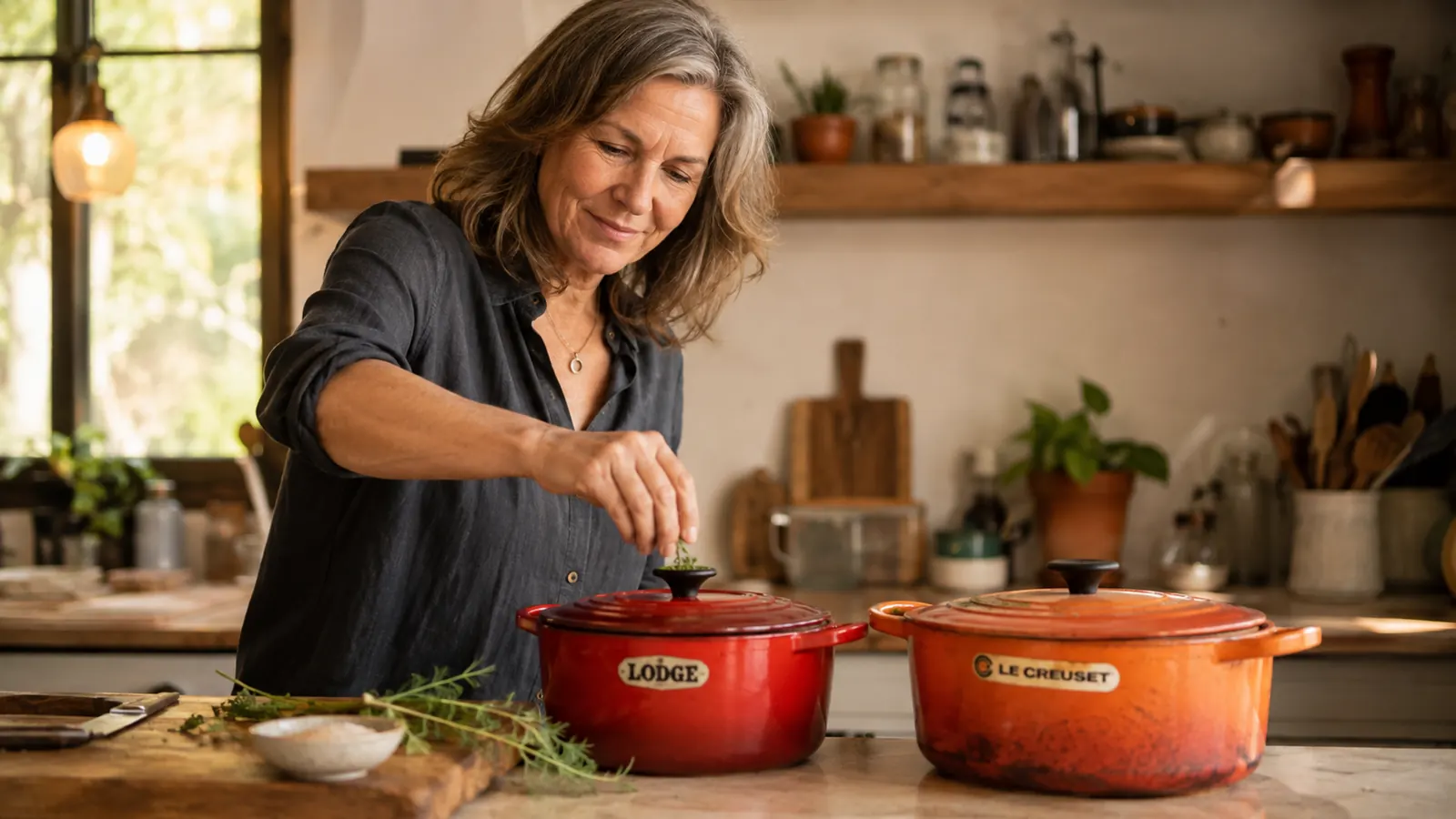
My Lodge Dutch oven has scorch marks on the inside rim that will never come out, and I love it anyway. It's the 6 quart Essential Enamel model, the one I use for Sunday sauce, Tuesday night braises, and the sourdough I bake most weekends, and it has lived on my stovetop or in a low cabinet for going on four years now. My sister-in-law has the same size pot from Le Creuset, the French brand every registry list points to, and for a while I told myself the only difference was the price tag. Then I actually cooked out of both pots for a season, side by side, same recipes, same stove, and found out that's not quite true. Neither pot is wrong. They're just answering different questions. We didn't just eyeball it either, we ran the same braise recipe in both pots on the same afternoon and compared the results side by side on the counter.
If you want the short answer before the specs, here it is. Lodge is the pot I'd tell a first time Dutch oven buyer to get, full stop. It does most of what the Le Creuset does, for roughly a quarter of the price, and it can take a beating from a house with kids or a heavy hand. Le Creuset earns its keep if you already know you cook with cast iron for decades, you care about the enamel staying pristine, or you want a pot you'll actually leave your kids in the will. Both are enameled cast iron, both braise a chuck roast into something worth bragging about. The difference lives in the details, and those details cost real money.
| Lodge | Le Creuset | |
|---|---|---|
| Price today | Mid-range for the 6 quart, check today's price on Amazon | Premium tier for a comparable 5.5 quart |
| Weight (6 qt comparable) | About 15.5 pounds empty | About 13.5 pounds empty for the closest comparable size |
| Handle clearance | Wide, rounded loop handles, easy grip with thick oven mitts | More tapered, refined handles, tighter fit with a bulky mitt |
| Interior enamel over years | Fine staining and light crazing typically appear by year two or three | Thicker, multi layer enamel resists staining and crazing much longer |
| Oven safe temp | Rated to 500°F, metal lid knob included | Rated to 500°F on most models, some knob styles limited to 480°F |
| Warranty and service | Limited lifetime warranty against manufacturing defects | Lifetime warranty with a widely reported responsive service reputation |
| Chip resistance from daily use | Thick cast walls shrug off knocks against the faucet or a stove grate | Chips more easily on hard impact despite the heavier price tag |
| Resale and heirloom value | Rarely resold, low secondhand demand | Holds real value secondhand, actively traded even decades later |
| Color options | A handful of standard colors | Dozens of colors and finishes across the line |
Where Lodge Wins
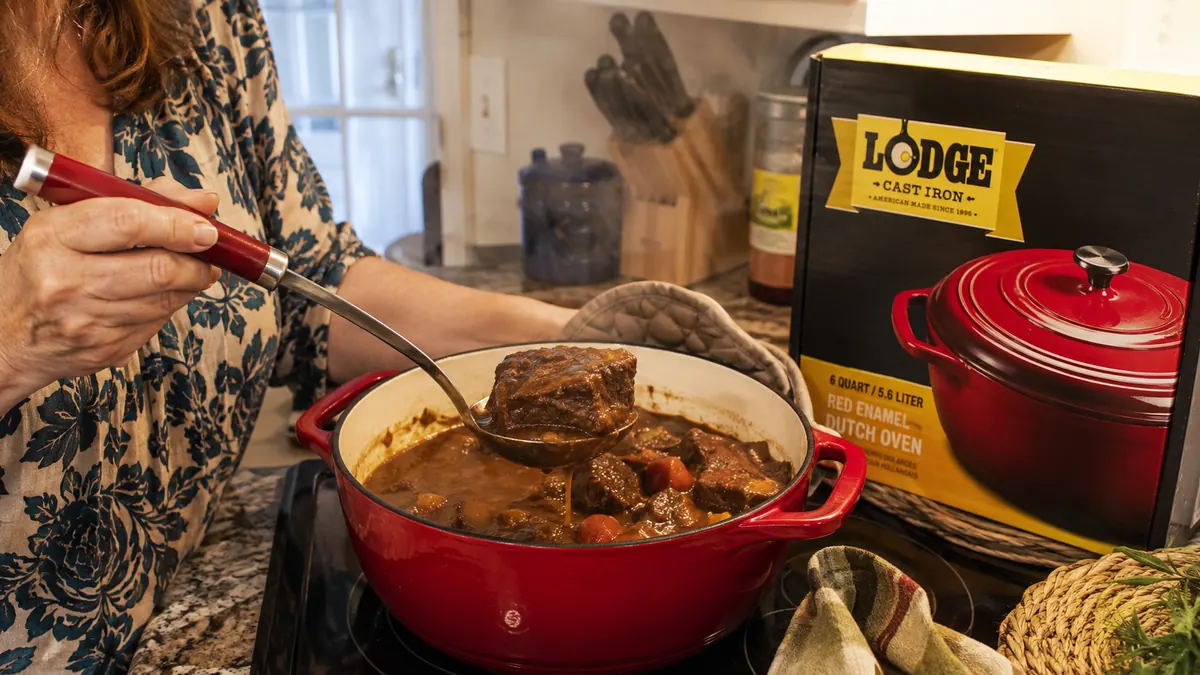
Lodge wins the argument most people are actually having, which is value. My Lodge cost well under a hundred at today's price, and in four years of near daily use it has never chipped, even after I dropped the lid on the tile floor moving it out of the dishwasher, a mistake I do not recommend repeating. The walls are thick enough that I don't baby it. I've scraped it with a metal spoon more times than I'd admit to a Le Creuset owner, and the enamel has taken the abuse without flaking. For a working kitchen where the pot gets knocked against the faucet or set down harder than it should be, that thickness is the whole point. Lodge built this for people who cook every night, not for a display shelf.
The handles are the other place Lodge quietly wins. They're wide, rounded loops set far enough from the body that I can grip them with my thick silicone oven mitts without scorching a knuckle, which happens to me constantly with narrower handles. The lid knob is oversized too, easy to grab one handed while I'm stirring with the other. None of this shows up in a glossy photo, but it shows up every single weeknight when I'm pulling a five quart pot of braised short ribs out of a 325 degree oven with one hand while my other hand is holding the oven door. Le Creuset's handles are more refined looking. Lodge's are built for someone actually cooking dinner. Le Creuset's lid knob, on some models, also runs hotter to the touch during a long bake, which is a small thing until you've forgotten twice in one week.
Where Le Creuset Wins
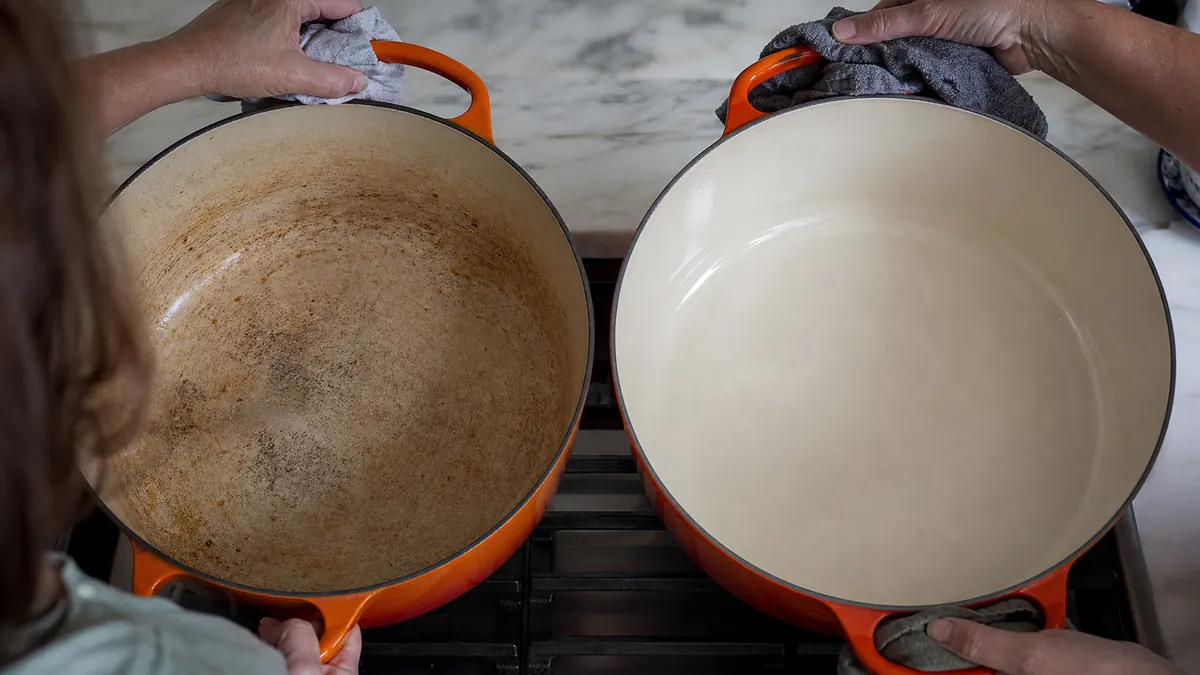
Le Creuset wins on the enamel itself, and this is the part I didn't believe until I lived with both pots. My sister-in-law's Le Creuset is nine years old and the interior still looks close to new, pale and even, no real staining beyond what a Bar Keepers Friend soak fixes in five minutes. My Lodge, by comparison, picked up faint gray staining around the three year mark from tomato sauce and browned butter, cosmetic only, it doesn't affect cooking, but it's there. Le Creuset uses a thicker, multi layer enamel application that resists that kind of staining and fine surface crazing for longer. If you're the type who notices a pot's finish the way some people notice a scratch on a car, that difference matters more than it should.
Le Creuset also wins on the long tail, warranty and resale. Le Creuset's lifetime warranty and customer service reputation are well known among people who've actually had to use it, and secondhand Le Creuset pots, even decades old ones with a few scratches, still sell for real money because the brand holds its value. Lodge's warranty is solid too, but nobody is buying a used Lodge Dutch oven on Facebook Marketplace for a premium when a new one costs about the same. If you think of cookware as something you'll hand down, or something you might resell if you ever downsize your kitchen, Le Creuset's name is doing real work for you there in a way Lodge's isn't trying to.
Not ready to spend Le Creuset money on a pot you're still deciding about?
The Lodge Essential Enamel Dutch Oven does the same braising, baking, and Sunday sauce work for a fraction of the price, and it can take a real kitchen's worth of abuse while you figure out if cast iron is even your thing.
Amazon Check Today's Price on Amazon →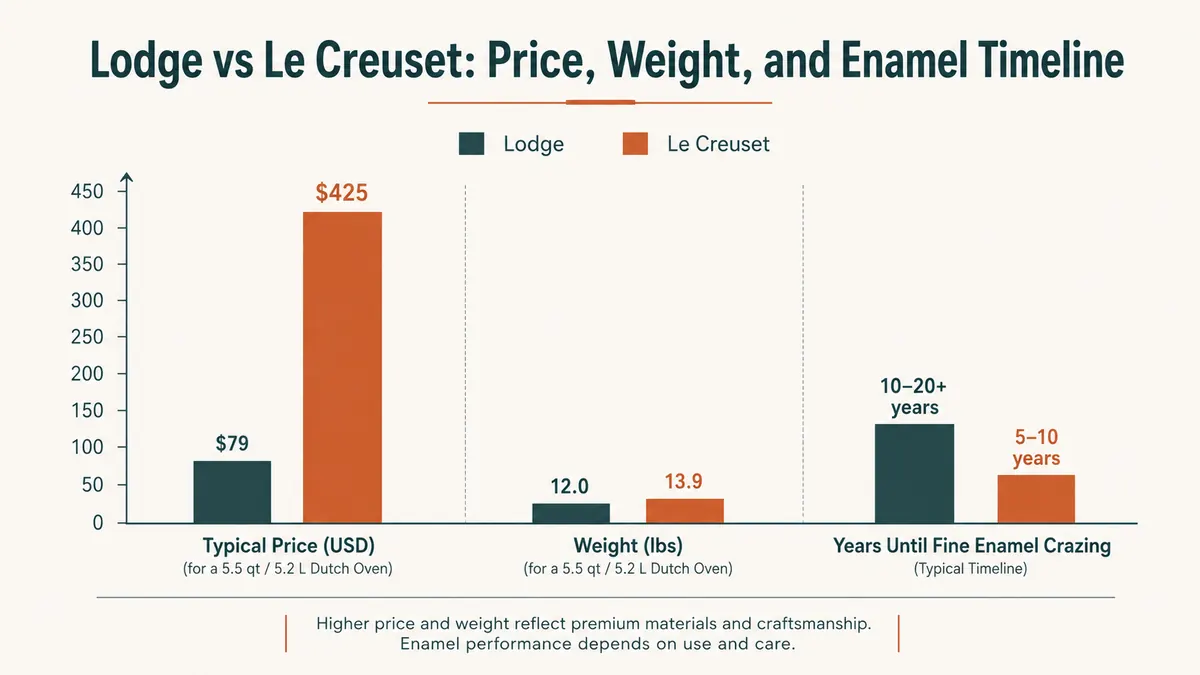
How I Actually Tested Both
I didn't do a showroom test where you tap the enamel and nod. I cooked out of both pots for about six weeks, alternating between my kitchen and my sister-in-law's, same recipes each time, a braised chuck roast, a no knead sourdough loaf baked in a preheated pot, a pot of chili that sat on low heat for four hours, and a batch of caramelized onions that takes a stubborn hour of babysitting either way. I wanted to know if the extra money bought better cooking, not just a nicer look.
On the actual cooking, they performed almost identically. Both pots hold heat evenly enough that I never got a scorched ring on the bottom of the chili, and both baked bread with the same deep, blistered crust. If you're buying a Dutch oven purely to cook better food, that's the honest headline. The Lodge does not cook worse than the Le Creuset. The differences I found live in daily handling and long term wear, not in what ends up on the plate.
The one cooking difference I could point to, and it's a small one, showed up with the bread. Both loaves had a crackling crust, but the Le Creuset loaf browned about two minutes faster, likely because its enamel exterior holds and radiates heat slightly differently than the Lodge's. I had to pull it early to keep it from going past deep golden into burnt. It's the kind of difference you'd only notice if you were baking both loaves back to back, which almost nobody actually does.
The Lodge does not cook worse than the Le Creuset. It just doesn't age quite as gracefully, and it doesn't need to.
The Enamel Durability Question
Fine crazing, the tiny hairline cracks that show up in enamel over years of heat cycling, happens to almost every enameled cast iron pot eventually, Lodge and Le Creuset both. It's cosmetic, not structural, and I've never had it affect how a pot cooks. What I noticed is that it shows up sooner on Lodge, usually somewhere in year two or three of regular use, and it shows up later on Le Creuset, sometimes not until year seven or eight. If crazing bothers you, expect to see it either way eventually, just on a different timeline depending on which pot you buy.
Care matters more than brand here. Both pots last longer if you let them cool before running cold water over them, avoid the dishwasher even though both claim to tolerate it, and skip the metal utensils when you remember to. I don't always remember, and my Lodge has forgiven me for it. That forgiveness, more than any spec sheet, is why I still reach for it most nights.
What the Price Gap Actually Buys
It's fair to ask what four hundred extra dollars actually buys, because on paper these are both enameled cast iron pots doing the same job. Some of it is real, the enamel application, the manufacturing process, the customer service reputation, the resale market. Some of it is brand, plain and simple, the recognizable orange or blue pot on a wedding registry that says something about the gift even before anyone cooks with it. I'm not going to pretend that's worthless, gifts carry meaning, but if you're buying for yourself and nobody's watching, you're paying a lot for polish on top of a pot that braises a chuck roast about as well as one that costs a quarter as much. Lodge just doesn't ask you to pay for the name. I priced out what that difference could buy instead: a good chef's knife, a sheet pan set, and still money left over for a bag of good coffee.
The one place I'd tell you not to cut corners is size. Whichever brand you land on, get at least a 5.5 to 6 quart pot if you're cooking for more than two people regularly. I made that mistake with a smaller pot years ago and spent a year crowding braises that needed more room to actually reduce properly. Brand matters less than getting the size right for how you actually cook.
Who Should Buy Which
Buy the Lodge if you're new to Dutch ovens, you cook on a budget, or you know your kitchen is a working kitchen where things get knocked around. I wrote up the long version of how mine has held up after years of near daily cooking in my long-term Lodge Dutch oven review, and I go through the specific things I'd flag before you buy in my honest Lodge Dutch oven review. Buy the Le Creuset if the enamel finish and resale value genuinely matter to you, if you're buying one pot to last the rest of your life and don't mind paying for that promise, or if it's a gift where the name on the box is part of the point. Most people cooking dinner five nights a week are better served putting the difference in price toward a good knife or a second pot instead. I've been asked more than once whether the Lodge is 'good enough' to skip the upgrade entirely, and after four years of using it as my only Dutch oven, my answer is yes, it is.
Still deciding? Start with the pot that won't punish a wrong guess.
At today's price, the Lodge Essential Enamel Dutch Oven is the lower risk way to find out if you're a cast iron person before you commit Le Creuset money to the question.
Amazon Check Today's Price on Amazon →