

My Lodge Dutch oven has a chip in the enamel on the rim, right where I bang it against the faucet every time I drain pasta water into it by accident. I'm not going to pretend it's pristine. I bought the 6-quart Lodge Essential Enamel Dutch oven a little over two years ago, after my old aluminum stockpot warped on the stove during a Sunday chili session, and it has cooked something in my kitchen almost every week since.
I'm Delia. I cook most nights for a household of four, I do my own home repairs, and I don't buy cookware based on how it photographs. I buy it because I'm tired of replacing things. So this is a real review of what the Lodge Dutch oven does after two years of braises, soups, chili, and more loaves of no-knead bread than I can count, not a first-week impression written the week the box arrived.
Two years is long enough to see past the honeymoon period every new pot gets. That's when the enamel is unmarked, the lid still smells faintly of the box it shipped in, and everything looks great in a photo. What I care about, and what I think most people shopping for a Dutch oven actually want to know, is what the pot looks and cooks like once real life has had a shot at it.
The Quick Verdict
Heavy, heat-retentive, and honestly built for the price. The enamel chips a bit faster than the pricier brands, but nothing that affects how it cooks.
Amazon Check Today's Price →Tired of pots that warp before the warranty card hits the recycling bin?
The Lodge Dutch oven is the one pot in my kitchen that hasn't let me down in two years of daily use. See today's price and current availability on Amazon before you decide.
Amazon Check Today's Price on Amazon →How I've Used It
I didn't buy this to make one showcase meal and put it on a shelf. In the first six months I used the Lodge for a weekly Sunday braise, usually a chuck roast or short ribs, plus at least one soup a week and a no-knead bread loaf every other Saturday. That's roughly 90 cooking sessions before I'd even call it broken in.
Since then it's settled into a rotation: chili in the fall, French onion soup on cold nights, a braised chicken thigh dish my husband requests constantly, and bread almost every weekend from October through March. It lives on my stovetop, not in a cabinet, because at 6 quarts and around 15 pounds empty, I genuinely don't want to lift it out of a low cupboard twice a day.
I also run it through the full range of what a Dutch oven is supposed to do: stovetop searing, oven braising at 325°F for hours, and the occasional 450°F bread bake with the lid on. If a pot is going to reveal a weakness, doing all three regularly for two years will find it.
I've also loaned it out twice, once to my neighbor for a holiday turkey brine and once to my daughter for a college apartment potluck, and both times it came back with a scuff or two I hadn't put there myself. That's the other side of owning a pot people actually want to borrow. It gets used hard by more than just me.
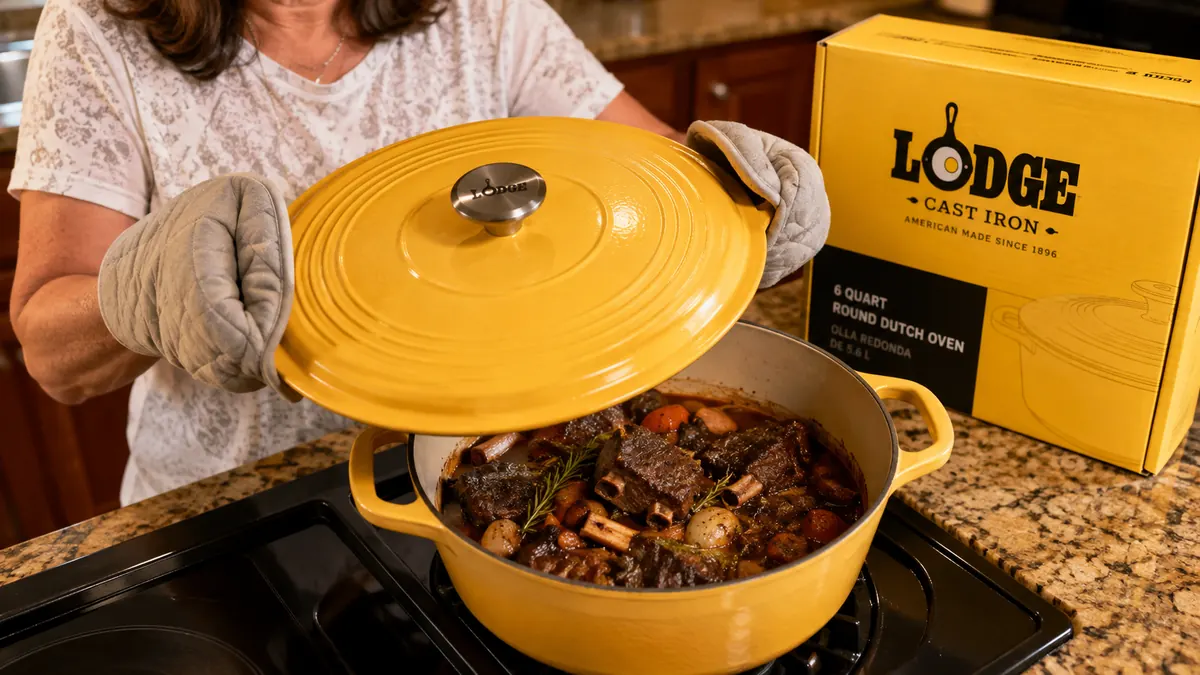
The Enamel Coating After Two Years of Real Cooking
This is the part everyone actually wants to know: does the enamel hold up. On the inside cooking surface, yes, close to perfectly. The interior enamel on my Lodge is a light cream color, and after two years of tomato-based braises, wine reductions, and the occasional overzealous high-heat sear, it's stained a bit but shows no cracking and no bare cast iron peeking through.
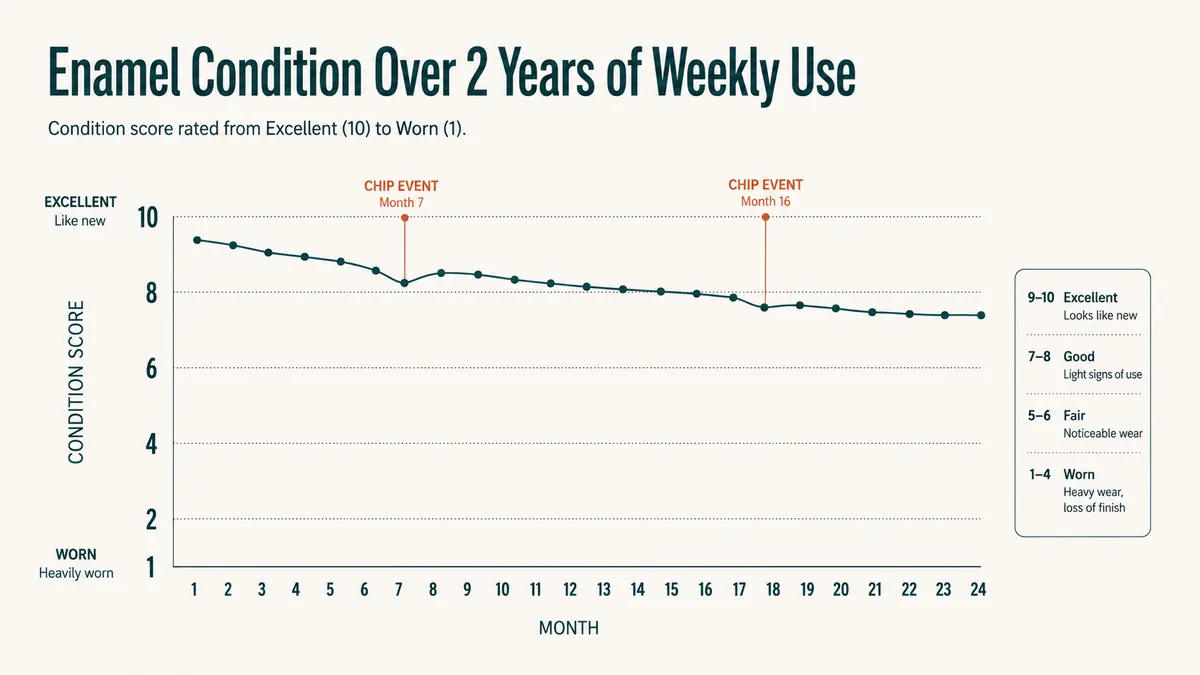
The exterior is where I've taken damage. I have one chip near the rim from that faucet incident I mentioned, and a smaller one on the bottom edge from setting the pot down too hard on my stove grate one night when my hands were full. Neither chip goes through to bare metal, they're surface-level in the enamel, but they're visible if you look for them. I've read enough reviews of Le Creuset to know this isn't unique to Lodge, every enameled cast iron pot chips if you're careless with it near hard surfaces.
What matters more to me is that the chips haven't affected cooking performance at all. No rust has formed, nothing has spread, and the pot still holds heat exactly like it did the first month I owned it. The staining on the interior wipes down fine with a baking soda paste when it gets ahead of me, and I've never needed anything harsher. If you want a full breakdown of how the Lodge enamel compares to the pricier competition, I wrote up a direct side-by-side comparison of the Lodge and Le Creuset Dutch ovens after testing both in my own kitchen.
Braises, Soups, and Sunday Bread: Performance Over Time
The thing that sold me on the Lodge in the first place was heat retention, and two years in, that hasn't changed one bit. A chuck roast braise that goes in at 325°F stays at a low simmer for the full three hours without me touching the oven dial, and the pot holds enough residual heat that I can turn the oven off fifteen minutes early and let carryover heat finish the job.
Bread is where the Lodge earns its keep in my house. Baking a crusty loaf inside a preheated Dutch oven traps steam against the dough in a way a sheet pan never can, and that steam is what gives you a shatter-crisp crust instead of a soft, pale one. I go into the mechanics of exactly why that happens in 10 reasons bread bakes better in a Dutch oven, but the short version is that the Lodge's thick cast iron walls and tight-sealing lid do the job just as well as ovens costing three times as much.
Where I've noticed the Lodge is genuinely different from a cheap stamped-steel pot is in even heating. I don't get hot spots that scorch the bottom of a soup while the edges stay lukewarm. The cast iron base spreads heat out slowly and holds it, which means less stirring and fewer scorched pots at the bottom of my sink.
It's also the pot I reach for when I'm making a big batch of anything, applesauce in the fall, a double batch of marinara to freeze, stock from the Thanksgiving carcass, because the walls are thick enough that I'm not babysitting it against scorching the way I would with a thinner pot on the same burner.
The Lid, the Handles, and the Small Design Choices That Matter
The Lodge lid has a slightly domed shape with small spikes on the underside, which Lodge markets as a self-basting feature. In practice, condensation gathers on those bumps during a long braise and drips back down onto the food instead of collecting on the sides. I can't prove it makes a huge difference in moisture, but my braises have never come out dry, so I'm not arguing with it.
The two side handles are wide and a little rough-textured, which I actually prefer, because a wet oven mitt doesn't slide on them the way it does on the smooth cast handles I've used on other brands. They're also positioned high enough off the rim that I can get four fingers under each one, which matters a lot when you're lifting a full pot of soup one-handed while holding a lid with the other.
The one design gripe I have is the lid knob. It's a plain metal loop, not heat-safe silicone, and it gets hot enough after a long braise that I've reached for it barehanded out of habit more than once and immediately regretted it. It's a small thing, but after two years I'd still trade it for a wooden or silicone knob if Lodge offered one.
Where the Lodge Falls Short
I'm not going to sit here and tell you this pot is flawless, because it isn't. The exterior enamel chips more easily than the enamel on a Le Creuset I've cooked with at my sister's house, and if you're the type who stores pots stacked inside each other in a cabinet, expect more scuffing than you'd get from a pricier brand with a slightly more durable glaze.
It's also heavy. At close to 15 pounds empty and closer to 20 once it's full of braising liquid and a roast, this isn't a pot I'd hand to my mother-in-law with her wrist issues. If you have grip strength or joint concerns, the weight of any enameled cast iron Dutch oven, Lodge included, is worth thinking hard about before you buy.
And the color options are limited compared to what you'll find from boutique cookware brands. Mine is the standard red, and that's about the extent of the personality it brings to the table. If matching your kitchen's exact color scheme matters to you, you may end up disappointed, since Lodge just doesn't chase trend colors the way some of the higher-end brands do.
Alternatives I Considered Before Buying the Lodge
Before I bought the Lodge, I seriously looked at a Staub cocotte and, of course, the Le Creuset everyone talks about. Both are excellent pots. Both are also a good deal more money for what amounted to, in my testing, a marginally more chip-resistant enamel and a slightly heavier lid for better moisture retention.
I couldn't justify the price difference for my kitchen, and two years later I still can't. I wrote a full comparison after using both pots side by side for a month, and if you're stuck deciding between the Lodge and the pricier option, that breakdown lays out exactly where the extra money does and doesn't buy you something real.
What I Liked
- Holds heat evenly through long braises without hot spots
- Interior enamel has stayed crack-free after two years of weekly use
- Wide, textured handles are easy to grip with an oven mitt
- Bakes bread with a genuinely crisp, steam-baked crust
- Priced well below Le Creuset and Staub for comparable cooking performance
Where It Falls Short
- Exterior enamel chips more easily than pricier competitors if bumped on hard surfaces
- Lid knob gets hot and isn't heat-safe to grab barehanded
- Heavy at close to 15 pounds empty, harder to manage for anyone with grip or joint issues
- Limited color selection compared to boutique brands
It's not the prettiest pot in my kitchen anymore, chips and all, but it's the one I reach for without thinking, and after two years that says more than any first impression could.
Who This Is For
If you cook regularly, meaning a few times a week rather than a few times a year, the Lodge is worth the counter space. It's a genuine workhorse for braises, soups, chili, and bread, and it does all of that without needing to be babied. If you're replacing a warped stockpot or a nonstick pan that's finally quit on you, this is a real upgrade that will outlast both.
It's also a good fit if you want the enameled cast iron experience, the even heat, the oven-to-table look, without paying Le Creuset prices for it. For most home cooks, the performance gap between the Lodge and the boutique brands is small enough not to matter, and the money saved buys a lot of groceries.
Who Should Skip It
If lifting a heavy pot full of liquid isn't something you want to deal with regularly, look at a smaller size or a lighter material entirely. And if you're the kind of cook who stacks pots in a tight cabinet and cares a lot about keeping the exterior looking showroom-new for display purposes, budget for a brand with a tougher exterior glaze, or be ready to treat this one gently.
Ready to stop babying cookware that can't handle a real week of cooking?
Two years of weeknight braises, chili, and Sunday bread later, the Lodge is still the pot I reach for first. Check today's price on Amazon and see if it's the right fit for your kitchen.
Amazon Check Today's Price on Amazon →