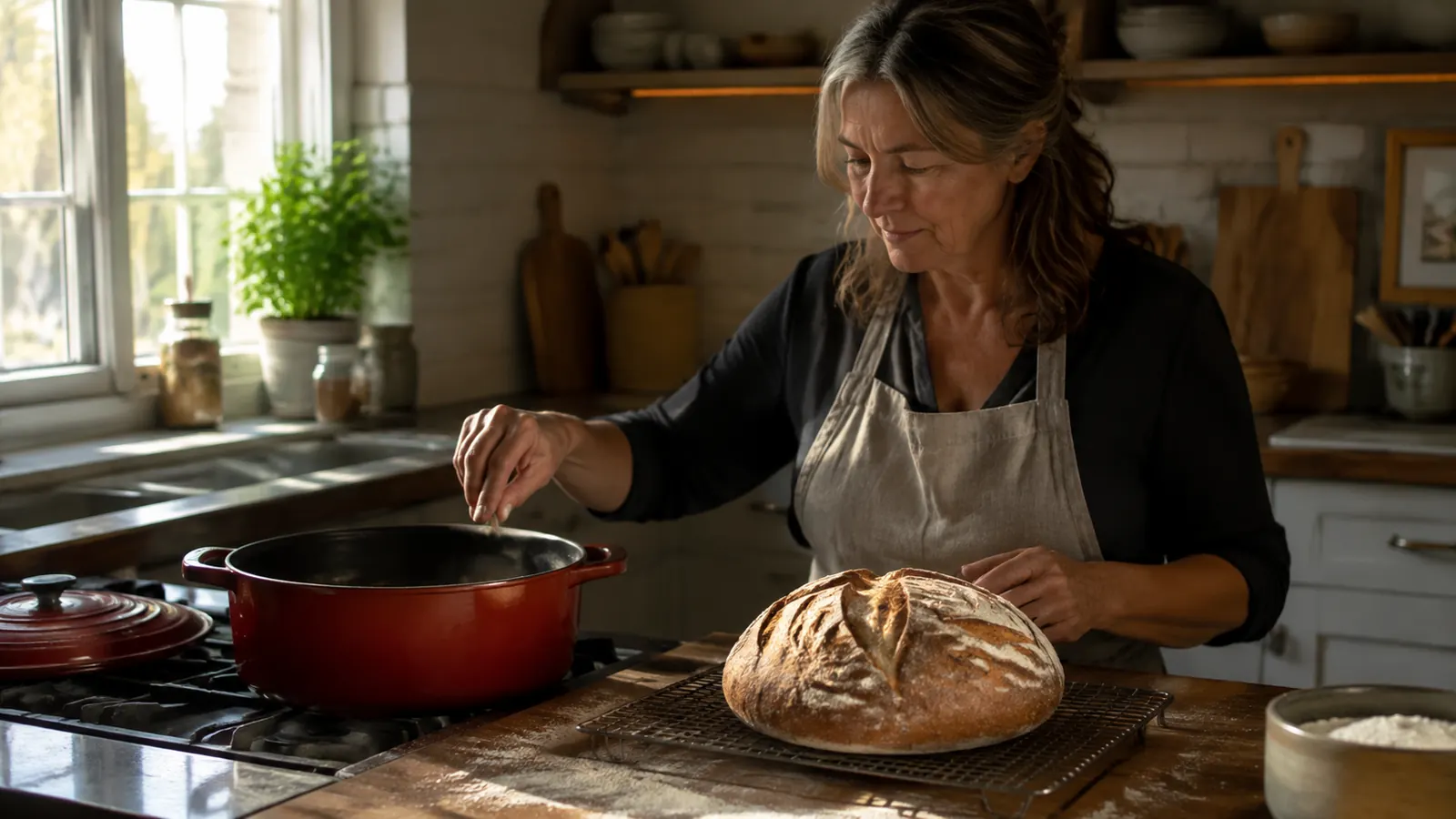
For three years I baked flat sourdough. Not bad, flat. The kind of loaf that tastes fine but looks like it gave up halfway through proofing. I blamed my starter first, then my flour, then the humidity in my kitchen in July, then my oven's thermostat, which I actually had tested by a repairman who told me it was running four degrees hot and otherwise fine. None of that was it. It took a Lodge Dutch oven, of all things, to show me what I had been missing the whole time.
It was the pot. Or really, the lack of one. I'd been baking on a plain steel sheet pan the whole time, which meant every bit of steam my dough threw off in the first ten minutes just floated away into my oven instead of staying trapped around the loaf where it belonged. That steam is what gives sourdough its blistered, crackling crust and the oven spring that makes a boule look like a boule instead of a very round pancake. I didn't know that until I actually read up on it, and even then I resisted buying a Dutch oven for another eight months because I already had four pots I barely used.
What finally moved me was my neighbor Fran, who bakes twice a week and has for as long as I've known her. She brought over a loaf for a block party that had this deep mahogany crust with ears on it, the little ridges that split open along the score line. I asked what she did differently and she just said, "Lodge Dutch oven, that's it, that's the whole trick." I went home annoyed, because I'd spent months chasing a fix that turned out to cost eighty some dollars and about ten minutes of research.
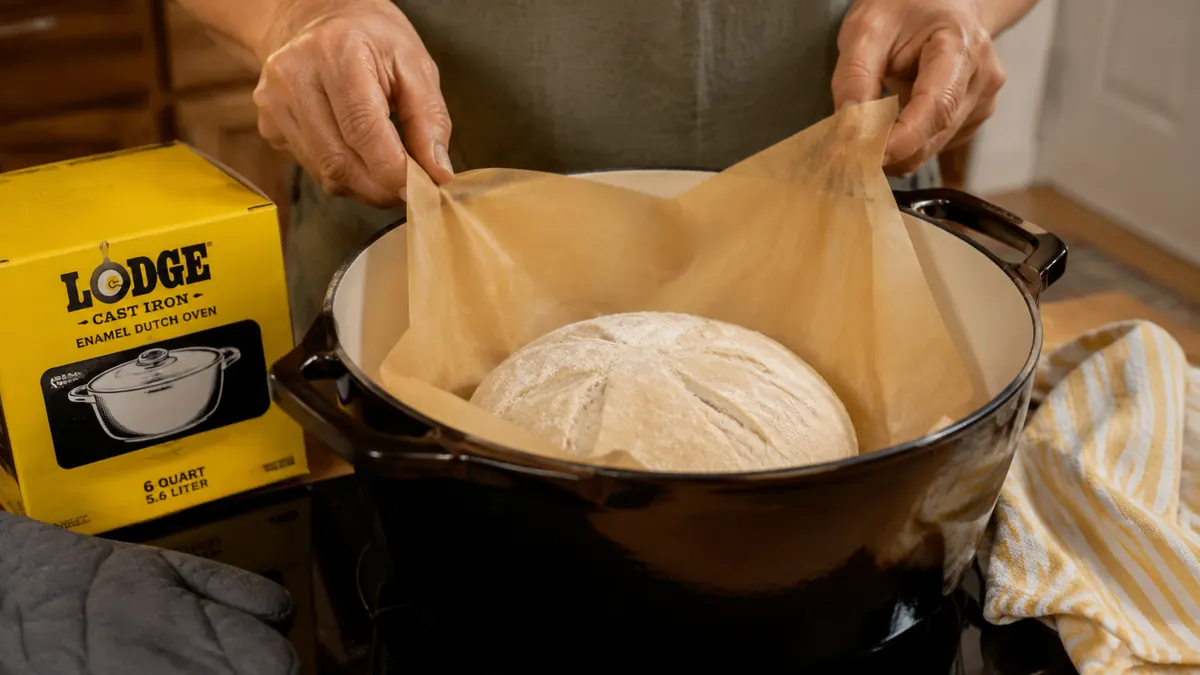
I bought the Lodge 6 quart enamel Dutch oven that same week, mostly because it was the one Fran actually owned and I trust her more than I trust a review site I've never heard of. It's cast iron under the enamel, dual loop handles, the kind of moisture sealing lid that's specifically built to trap steam rather than vent it off. Heavy is an understatement. My husband picked it up empty out of the box and asked if I'd bought a boat anchor by mistake.
The first loaf I pulled out of the Lodge had ears. Actual ears. I'd never gotten that in three years of trying.
The pot that fixed three years of flat loaves
If your sourdough tastes right but never looks right, the problem is probably steam, not your starter. This is the pot that solved it for me.
Amazon Check Today's Price on Amazon →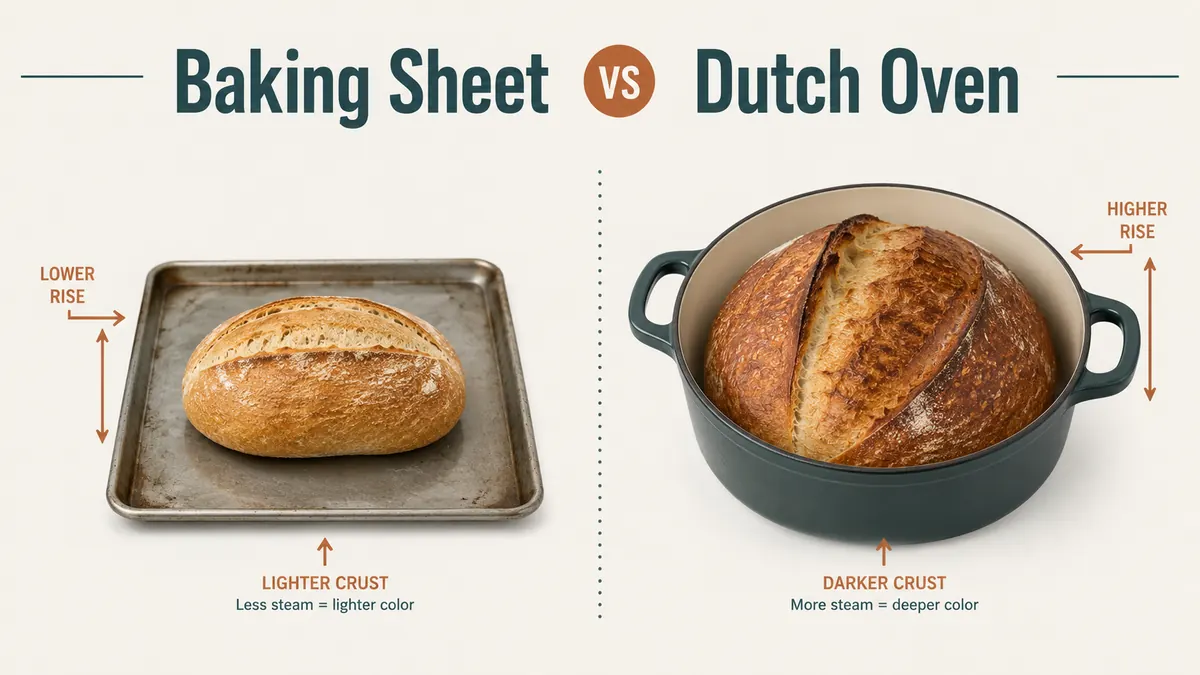
The routine is simple enough that I felt a little silly for having avoided it so long. Preheat the Lodge empty, with the lid on, for a full 45 minutes at 450. Drop the shaped dough in on a parchment sling, score it, lid back on, bake covered for 20 minutes so the steam does its work, then uncovered for another 20 to 25 so the crust actually browns instead of staying pale and soft. The first loaf I pulled out had ears. Actual ears, the kind that curl up along the score line. I stood in my kitchen holding it like I'd won something.
That was fourteen months ago now, and the Lodge has been in weekly rotation since. Not just for bread either. I braise short ribs in it every couple weeks in the winter, and it goes from stovetop searing straight into the oven without a second dish, which is the kind of thing that sounds minor until you've done dinner dishes for a family of five and realize you just saved yourself a pan.
It's not without its quirks. The enamel has a small hairline crackle near the rim from a scorch mark I gave it my second month, when I let it sit dry on high heat too long while I answered the phone. Lodge's enamel is more forgiving than some of the pricier French brands, but it's still enamel, and I've learned to respect it. I don't put it in the dishwasher, and I don't drop it into cold water straight off the stove. Basic care, the same rules that apply to any enamel cookware, but worth saying out loud since nobody tells you that when you buy it.
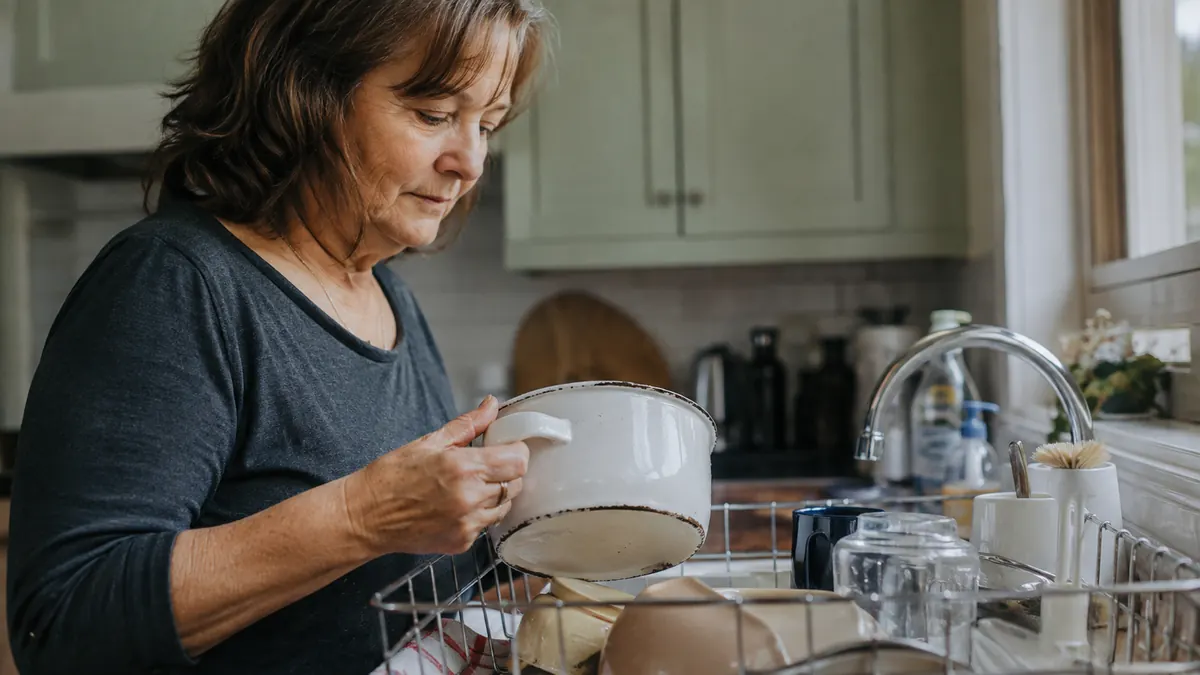
The lid handle also runs hot after a 45 minute preheat, hotter than I expected the first time, and I keep a silicone mitt specifically for pulling it. Small thing, but it caught me off guard once and I'd rather you know ahead of time than find out the way I did.
My daughter asked me last month why I don't just buy the fancier French one everyone posts online, the one in every bakery photo with the pastel finish. Honestly, I don't see the point for what I'm doing. The Lodge does the exact same job, traps the same steam, holds the same heat, and it cost me less than half of what hers did when she finally bought one. If I were opening a bakery I might feel differently. I'm baking bread for my family twice a week and braising a pot roast on Sundays, and for that, my Lodge has held up exactly the way I needed it to.
What I'd Tell You If We Were Sitting at My Kitchen Table
If you're where I was three years ago, blaming your starter or your flour or your oven, do yourself a favor and rule out the pot first. It's the boring answer, and boring answers are usually the right ones. You don't need the prettiest one on the shelf. You need something heavy, with a lid that actually seals, that you're not afraid to use every week because you're worried about scratching a finish you paid too much for. I go into more of the how and why over in the reasons bread just tastes better out of one of these if you want the fuller picture. But if you take one thing from me, take this: buy the pot before you buy anything else. Everything else I tried for three years was noise.
Rule out the pot before you blame anything else
It fixed my sourdough after three years of guessing. It might be the same simple answer for you.
Amazon Check Today's Price on Amazon →