
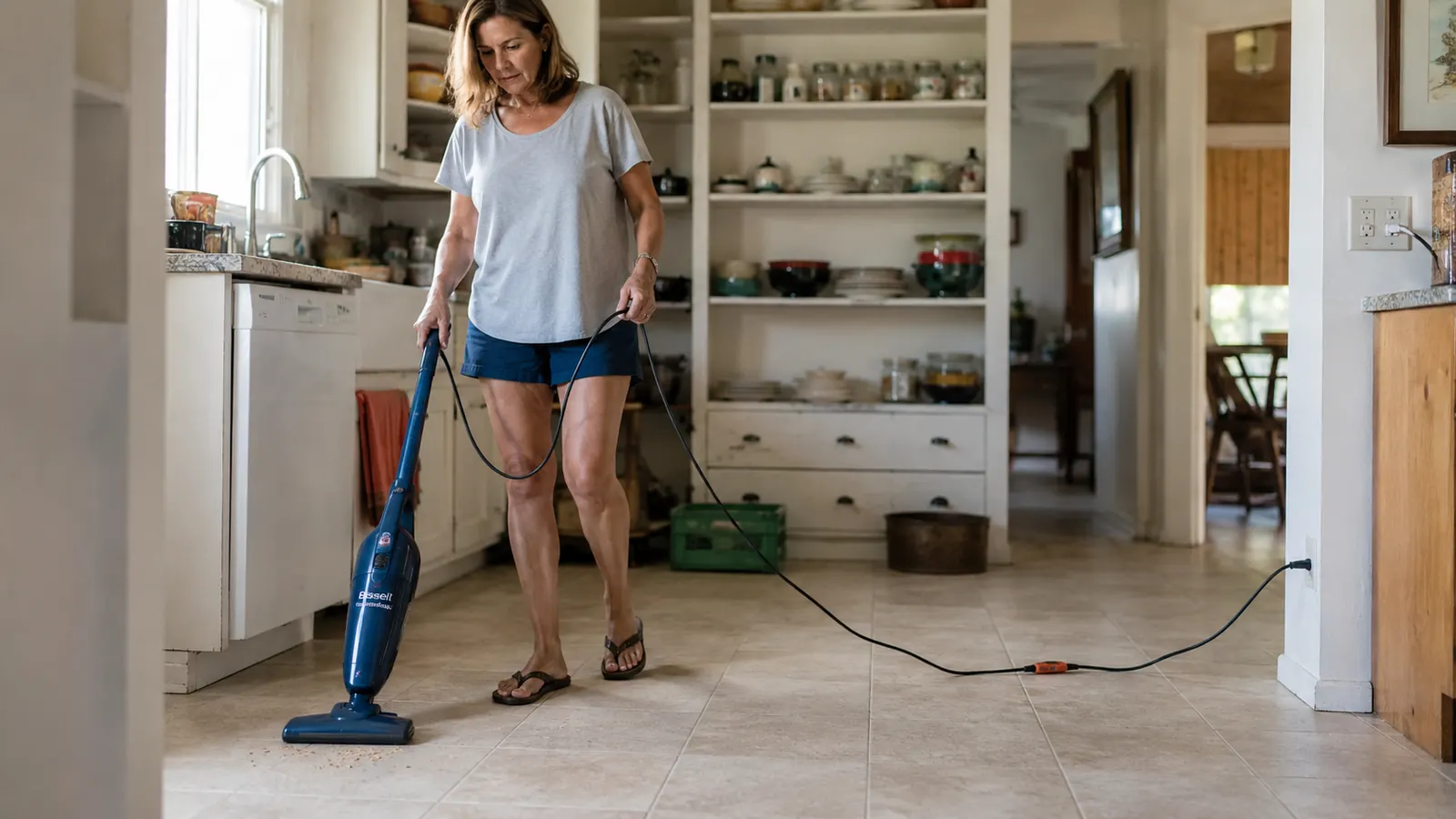
A friend of mine, Renata, texted me last month asking if the Bissell Featherweight was actually worth the money or if she should just save up for something cordless instead. I told her the honest answer isn't a clean yes or no, it's a list of specific things that either will or won't bother her, and most reviews skip straight past that list to get to the star rating. I've had this vacuum in daily rotation for over two years, and there are things about it nobody mentioned to me before I bought mine, things I only learned by living with it. This review is that list, the parts the marketing photos and the five-star reviews tend to leave out.
None of what follows means I regret buying the Bissell Featherweight. I don't. But I'd rather you go in knowing about the cord, the dust cup, the noise, and the carpet limitations before you click buy than have you discover them the way I did, mid-cleanup, mildly annoyed, wondering why nobody warned me.
I also think it's worth saying why so few reviews mention any of this. People who get mildly annoyed by a cheap vacuum usually don't write a review at all, they just quietly live with it or return it without explaining why. The ones who do write reviews tend to be either delighted or furious, and the honest middle ground, the small daily frictions that don't ruin the product but do shape how you feel about it, mostly goes unwritten. That's the gap I'm trying to fill here.
The Quick Verdict
A genuinely useful hard-floor vacuum for the price, but it has real friction points the glossy photos don't show you. Go in with eyes open and you'll be happy with it.
Amazon Check Today's Price →Here's what the five-star reviews don't mention
Check today's price on the Bissell Featherweight and see the current photos and specs for yourself before you decide if the tradeoffs below are ones you can live with.
Amazon Check Today's Price on Amazon →How I Actually Tested This, Beyond a Week Out of the Box
A lot of reviews get written in the first week of ownership, when everything still feels new and the honeymoon period hides the annoying stuff. I didn't want to write that kind of review, so I waited. I used my Bissell Featherweight across my own kitchen and hallway for two straight months before I let myself form an opinion, then I borrowed my sister's for a week to see if my unit's quirks were just mine or if they were built into the design. I also had my husband Ray run it over his garage workbench area, which gets a steady dusting of sawdust from his woodworking hobby, since that's a very different kind of debris than kitchen crumbs.
That combination, my kitchen, my sister's living room, and Ray's garage, gave me a much better read on where this vacuum genuinely earns its price and where it just gets by. The honest version of that read is below, section by section, rather than buried in one vague paragraph about how it's a decent budget option.
The Outlet Hunt Is Worse Than the Cord Length Suggests
Everyone who reviews this vacuum mentions the cord is roughly 20 feet, but almost nobody tells you what that actually looks like in a real house with a real floor plan. My kitchen outlet is behind the stove, my hallway outlet is behind a console table Ray built, and the two are just far enough apart that the cord goes taut about two-thirds of the way through a normal cleaning pass. I ended up buying a short, bright orange extension cord specifically for this vacuum, which lives coiled in a kitchen drawer now, and I genuinely didn't expect to need a dedicated accessory just to reach my own hallway.
This isn't a defect, it's just physics, and a corded vacuum built to sell for the price of a nice dinner out isn't going to ship with a 40-foot cord. But if your floor plan is spread out at all, plan on either an extension cord or a fair amount of unplugging and replugging mid-task. Nobody put that on the product listing when I bought mine, and I think it should be there.
The Dust Cup Fills Faster Than the Photos Suggest
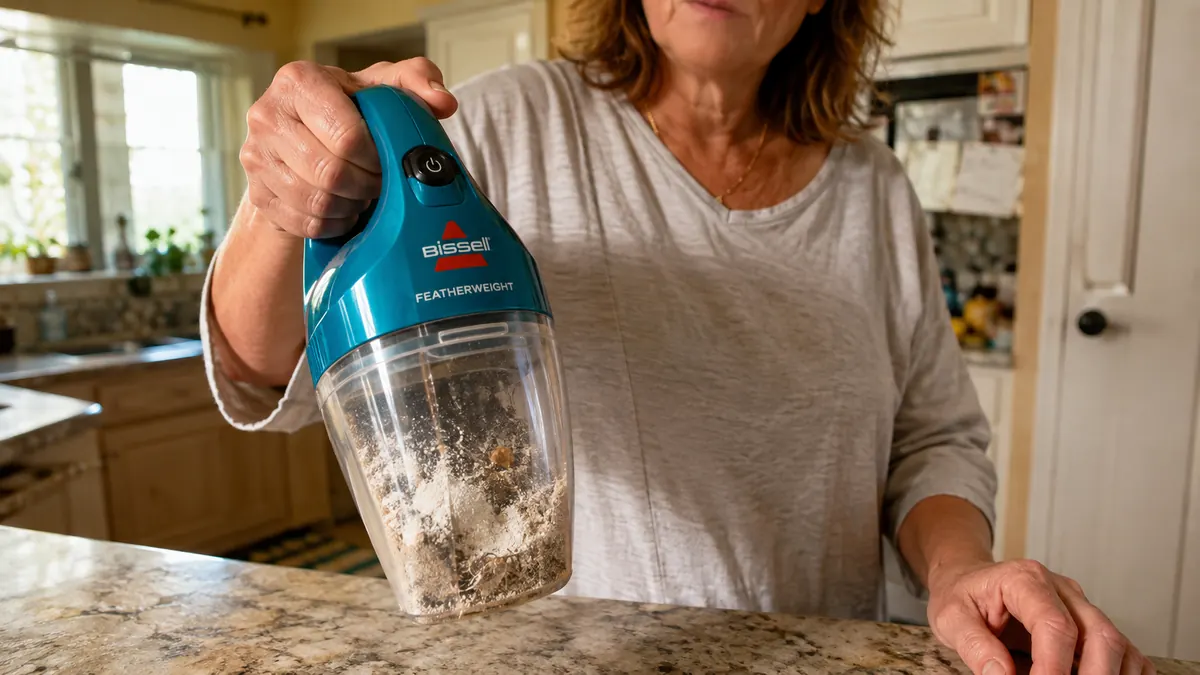
Product photos of the Bissell Featherweight make the dust cup look roomier than it is, probably because it's shot empty against a white background with nothing to compare it to. In real use it holds well under a pint before you're pushing debris into a cup that's already visually packed. On a normal day, kitchen and hallway only, I'm emptying it after every single use. After a bigger job, like cleaning up after Ray sanded a shelf in the kitchen doorway, I've had to stop and empty it twice mid-task, which is not something I expected from a vacuum with its own dedicated storage hook by the pantry.
If you're coming from a full-size upright with a bag or a large canister, this will feel like a downgrade in capacity, because it is. That tradeoff buys you the light weight and small footprint, and for my daily kitchen routine it's worth it, but budget extra time for emptying it more often than you'd guess from a quick glance at the listing photos.
Don't Expect Real Carpet Performance
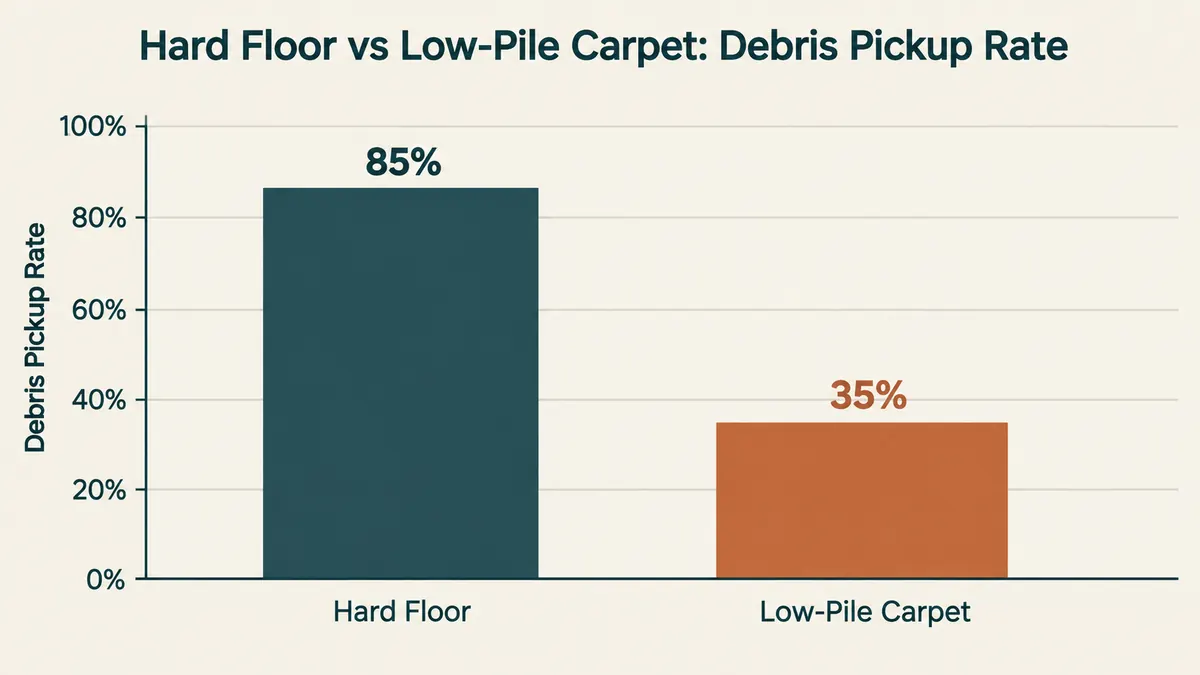
The box lists carpet right alongside hard floors, and technically it will roll over a rug without incident. But my sister has a low-pile carpet runner in her hallway, and when I ran the Bissell Featherweight over it during my borrowed week, it left visible crumbs and a light film of dust behind on every single pass. The brush roll just doesn't have the beater action or the suction depth to dig into carpet fiber the way an upright with a real motorized brush does. It skims the surface. On tile or laminate that's plenty. On carpet, even low-pile, it's closer to a light touch-up than an actual clean.
I go into the full side-by-side numbers in Bissell Featherweight vs Shark cordless, where carpet performance is one of the categories the cordless model actually pulls ahead on despite costing several times more. If your home is mostly carpeted, don't buy this expecting it to double as your primary vacuum. It won't, and pretending otherwise just sets you up to be disappointed with a tool that never claimed to be a carpet machine in the first place.
Emptying It Means a Small Dust Cloud, Every Single Time
This is the part almost nobody mentions, and it's the one that surprised me most. Because the Bissell Featherweight is bagless, emptying the dust cup means tipping fine, powdery debris directly into a trash can, and fine debris does not fall in a neat little clump. It puffs. My mother-in-law has mild dust sensitivity, and the first time she visited while I emptied the vacuum in the kitchen, she asked me to step outside to do it after that. I now empty mine over the trash can on the patio whenever I've picked up anything dry and powdery, like flour or drywall dust, because indoors that fine cloud just resettles right back onto the counter and the floor I was trying to clean.
It's not unique to this model. Every bagless vacuum does some version of this, it's just physics again, tiny particles behave differently than a sealed bag does. But it's genuinely worth knowing before you buy, especially if anyone in your house has allergies or asthma, because the emptying step deserves more caution than the product photos let on.

The Plastic Build Is Noisier Than You'd Guess From the Price
The Bissell Featherweight is almost entirely plastic, which is exactly how it stays under two pounds, so I'm not complaining about the material choice itself. What I wasn't ready for was the sound. The motor runs at a higher pitch than my old corded upright, closer to a dentist's drill than a vacuum hum, and the plastic housing has a faint rattle to it on hard floor transitions, like tile grout lines, that you don't get with a heavier metal-bodied machine. It's not loud in an alarming way, but it's not quiet either, and if you're vacuuming early on a Saturday while someone's still asleep down the hall, you'll want to wait.
None of this affects how well it cleans. It's purely a comfort thing, and after two years I barely register it anymore. But the first month, I noticed it every time, and I wish a review had told me to expect it instead of finding out mid-clean with a mug of coffee still in my other hand.
The Washable Filter Needs More Care Than the Manual Suggests
Tucked behind the dust cup is a small foam filter that has to be hand rinsed under the sink and then fully air dried before it goes back in, and the manual's guidance on drying time is optimistic. In our humidity here on the Gulf side, a genuinely dry filter takes closer to a full 24 hours than the quicker window the paperwork suggests, especially if you're drying it indoors with the air conditioning running rather than out on the patio in direct sun. I learned this the hard way early on, reinserted mine while it was still faintly damp in the center, and noticed a slightly musty smell coming from the vacuum within a week. A second rinse and a longer, patio dry took care of it.
Now I keep a spare filter on hand, ordered separately since only one ships in the box, so I can swap in a dry one and let the damp one finish drying on its own schedule instead of rushing the process. It's a small thing, a few dollars and a little planning, but it's exactly the kind of detail that never makes it into a five-star review and absolutely should.
The '3-in-1' Handheld Conversion, In Practice
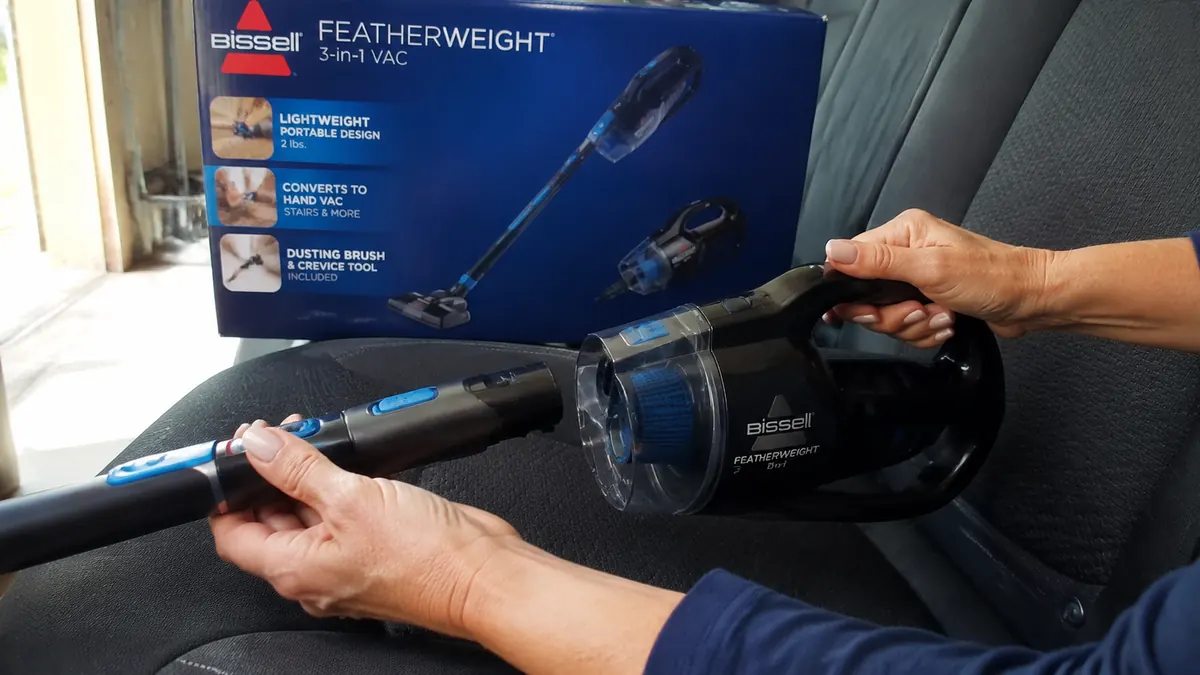
The listing calls this a 3-in-1 vacuum, meaning it converts from a full stick to a handheld unit for stairs, upholstery, and car seats. In theory that's a great feature for the price. In practice, converting it means pulling off the long wand, which takes both hands and a firm tug, and then holding a motor housing that's noticeably front-heavy once the wand is gone. It works fine for short bursts, like the inside of Ray's truck or the stairs down to the laundry room, but your wrist knows it's doing extra work within a couple of minutes. This isn't a dedicated handheld vacuum with its own balanced grip, it's a stick vacuum wearing a handheld costume, and that distinction matters if you were picturing something closer to a purpose-built car vacuum.
I still use the handheld mode a few times a month, mostly for the truck and the stairs, and it beats hauling out a separate appliance for those small jobs. Just don't expect the same comfortable grip you'd get from something designed as a handheld first. If you want the fuller picture on how this compares to going cordless entirely for that kind of flexibility, my long-term Bissell Featherweight review covers how the handheld mode held up after two full years of occasional use.
What I Liked
- Genuinely light at under two pounds, easy to grab one-handed for a quick job
- Suction on hard floors is strong for the price, no complaints there after two years
- Crevice tool built into the handle so it's never lost in a drawer
- Cheap enough that the small annoyances don't feel like a big financial risk
- Handheld conversion is a real bonus for car seats and stairs, even if the balance is imperfect
Where It Falls Short
- 20-foot cord means an extension cord is likely if your floor plan is spread out
- Dust cup holds well under a pint, so frequent emptying is part of the routine
- Carpet performance is a skim, not a real clean, even on low-pile
- Emptying it kicks up a visible dust cloud, best done outside if anyone has allergies
- Washable filter needs a full day to dry properly in humid climates
- Plastic housing runs a bit noisy and rattly on hard floor transitions
None of these are dealbreakers on their own. Stacked together, they're the difference between loving this vacuum and just tolerating it, and I'd rather you know that going in.
Who This Is For
This is for someone who wants a light, cheap, always-ready tool for hard floors and doesn't mind an extension cord, frequent dust cup emptying, and a bit of motor whine in exchange for the price and the simplicity. It's also a solid pick if you already own a full-size vacuum for carpet and just want a fast grab-and-go for the kitchen and hallway between real cleaning sessions. If you're the kind of practical shopper who reads the fine print before you buy anything, the Bissell Featherweight rewards that instinct, because nothing about it will surprise you once you know the list above.
It's also a genuinely good match for a household with young kids, where the mess is frequent but usually small, spilled cereal, tracked-in sand, that kind of thing, and you want something fast enough to grab between other tasks rather than a full production every time. If quick and cheap beats thorough and expensive for your daily routine, this checks that box.
Who Should Skip It
Skip this if your home is mostly carpeted, if your kitchen and living areas are far from any outlet, or if the idea of a small dust cloud during emptying genuinely worries you because of allergies in the house. Skip it too if you were picturing a true handheld vacuum for the car, since the conversion works but the balance isn't built for extended handheld sessions. For everyone else, mostly hard floors, a tight budget, and realistic expectations, it earns its spot by the pantry door, cord, noise, and all.
And skip it if the cord itself is a dealbreaker on principle, if you've decided you never want to think about outlets again while cleaning. That's a completely reasonable line to draw, it's just a different budget and a different product category than this one, and no amount of me talking up the suction is going to change which one you actually need.
Know the tradeoffs, then decide for yourself
See today's price and current availability for the Bissell Featherweight on Amazon. If the honest list above didn't scare you off, it's a solid, affordable pick for hard floors.
Amazon Check Today's Price on Amazon →